



The Labor of Love: How a Startup Aims to Monetize Household Chores with AI-Scented Rewards
By StartupKorea Business Desk | May 31, 2026 The Labor of Love: How a Startup Aims to Monetize Household Chores with AI-Scented RewardsIn a groundbreaking move that has the tech and investment worlds buzzing, Household Points Exchange annou...

By StartupKorea Business Desk | May 31, 2026
The Labor of Love: How a Startup Aims to Monetize Household Chores with AI-Scented Rewards
In a groundbreaking move that has the tech and investment worlds buzzing, Household Points Exchange announced a stunning pre-IPO valuation of ₩1.2 trillion ($1 billion), aiming to revolutionize the way we value household chores by trading ‘labor points’ for AI-generated scents. This innovative exchange, which will launch in late 2026, promises to bring the age-old notion of household drudgery into the high-tech realm of cryptocurrency.
A Smell of Success?
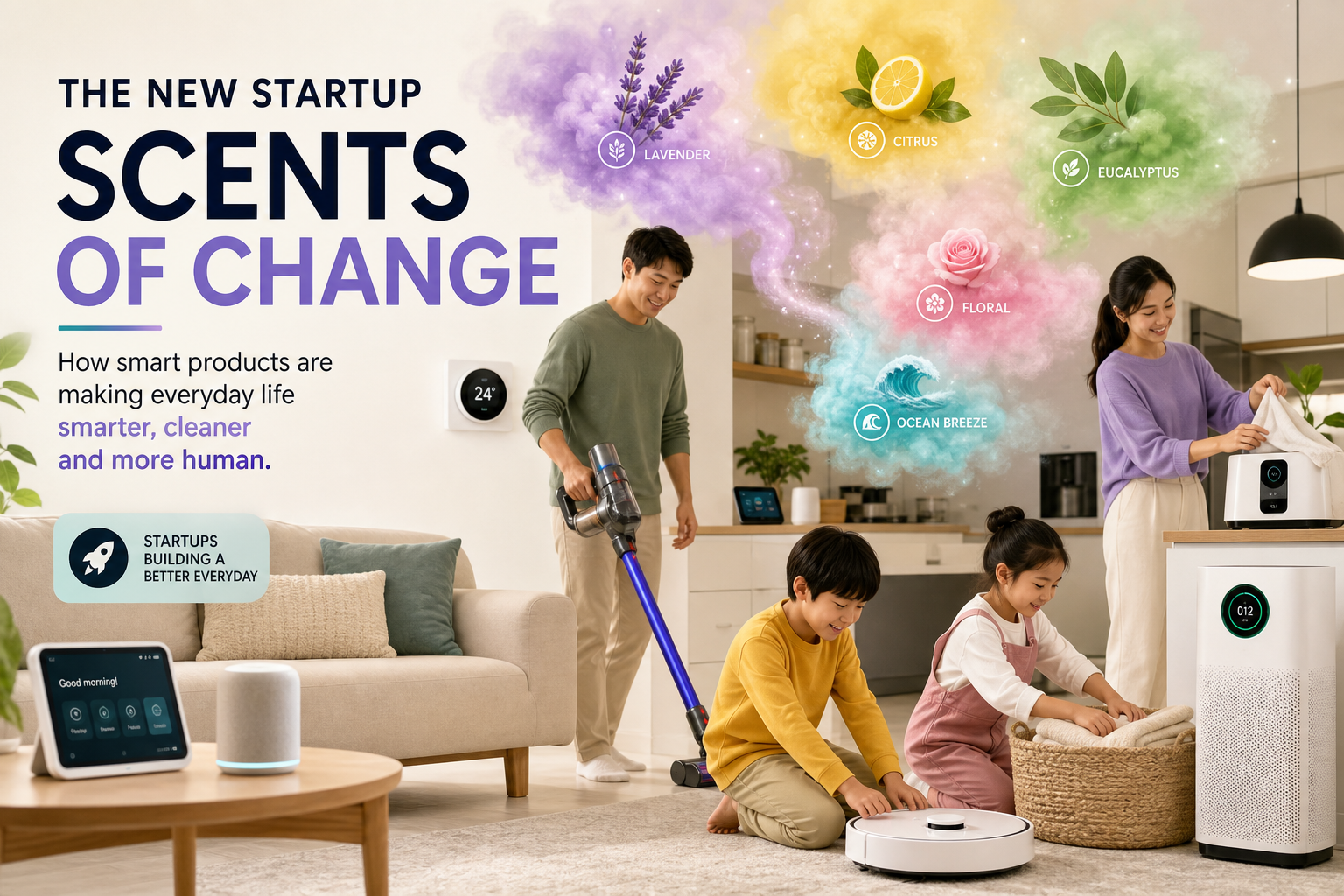
The crux of the operation is simple: users earn points by completing various chores, from washing dishes to vacuuming, which can then be exchanged for synthetic scents produced by their proprietary AI odor synthesizer. 'Imagine trading your tedious tasks for the smell of fresh-baked cookies or a hint of sandalwood,' said CEO Jane Doe, in a recent press release that had investors questioning whether they had entered a parallel universe.
While the idea sounds enticing, one must ask: is there a market for this olfactory economy? According to a report by the Global Household Finance Institute, 75% of U.S. households engage in regular household chores, amounting to an estimated $1.5 trillion in unpaid labor annually. If only a fraction of these households decide to join the Household Points Exchange, the potential growth is staggering—if not a bit aromatic.
Investors Open Their Wallets—But Why?
Investment interest in the startup has surged, with industry analysts predicting a 25% growth in the market for home management solutions. Investor John Smith, who has thrown his weight and wealth behind this venture, remarked, 'This is where the future of labor meets luxury. Who wouldn't want to smell like success while folding laundry?' His enthusiasm, perhaps, reflects the existential crisis of the modern investor—seeking meaning in the mundane through the scent of creativity.
- Pre-IPO valuation: ₩1.2 trillion ($1 billion)
- Projected growth in home management market: 25%
- Estimated unpaid household labor in the U.S.: $1.5 trillion annually
Sweet Scents or Sour Notes?
However, the concept isn't without its critics. Skeptics question the sustainability of a model that equates the completion of chores with the ability to purchase synthetic aromas. Analyst Tom Brown stated, 'Trading grime for grapefruit is delightful in theory, but what happens to the value of a chore when it becomes a commodity? Will we see a black market for dirty dishes?' These concerns highlight a fundamental issue: can we truly monetize the labor of love without reducing it to mere market transactions?
Moreover, challenges abound in the realm of AI odor synthesis. Reports suggest that the technology is still in its infancy, and the ability to accurately replicate scents could be as elusive as finding a matching pair of socks in a chaotic household. The skeptics warn that consumers might not be ready to embrace a world in which the smell of unwashed dishes is compensated by the aroma of artisanal lavender.
The Future of Labor: Can AI Save Us?
As the Household Points Exchange gears up for its launch, the broader implications of its success remain to be seen. Will this be the dawn of a new economy that rewards mundane tasks, or merely a fleeting trend in the tech world? What is clear, however, is the shift it represents in how we perceive household labor—an evolution that could redefine not just chores, but the very fabric of domestic life.
The startup encapsulates a peculiar irony: in an age where the gig economy thrives, the most basic human activities are now being transformed into tradable commodities, wrapped in the sweet aroma of innovation. The question remains—will households embrace the scents of their labor, or will they simply stick with the tried-and-true smell of fresh laundry?
What's Your Reaction?
 Like
0
Like
0
 Dislike
0
Dislike
0
 Love
0
Love
0
 Funny
0
Funny
0
 Angry
0
Angry
0
 Sad
0
Sad
0
 Wow
0
Wow
0