





Space Logistics for Smart Cities: A $500 Million Series A Bet on the Final Frontier
By StartupKorea Business Desk | Jun 01, 2026 The New Frontier: Space Logistics Platforms for Urban DevelopmentIn a move that may redefine the boundaries of both geography and common sense, Galactic Freight Solutions has secured a staggering...

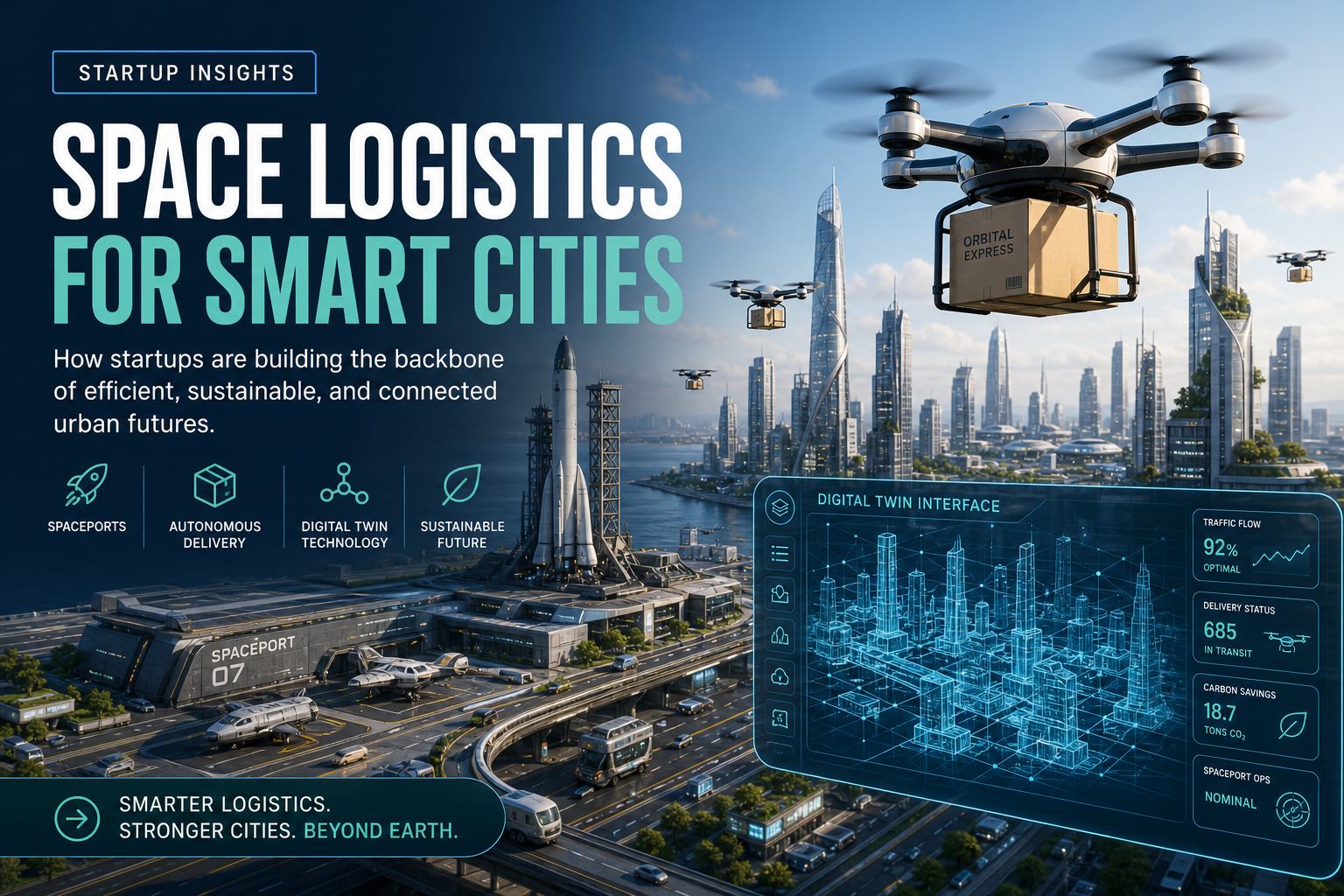
By StartupKorea Business Desk | Jun 01, 2026
The New Frontier: Space Logistics Platforms for Urban Development
In a move that may redefine the boundaries of both geography and common sense, Galactic Freight Solutions has secured a staggering $500 million in Series A funding to launch its revolutionary space logistics platform. Set against the backdrop of a world increasingly enamored with the idea of smart cities, this investment is said to herald a new era of urban transportation involving space-based supply chains.
Why Now? A Cosmic Convergence
With an estimated 1.5 million people expected to inhabit smart cities by 2030, the demand for innovative logistical solutions is at an all-time high. Add to this the accelerating pace of space exploration by private enterprises, and it seems that the stars have aligned—at least in the minds of the investors.
“We are at a critical juncture where the terrestrial meets the extraterrestrial,” stated Galactic Freight CEO, Orion Nebula. “Why ship goods across town when you can send them to the moon and back? It’s time to think outside the planet.”
The Investors' Cosmic Calculus
The $500 million investment came from a consortium of venture capitalists, who evidently believe that launching cargo into orbit is the next logical step in supply chain management. Renowned investor, Celeste Starship, commented, “We’re not in the business of just moving boxes. We’re in the business of moving entire ecosystems—beyond earthly constraints.”
Such rhetoric, while grand, raises eyebrows among skeptics who question whether consumers will ever consider interplanetary shipping a viable option. “Why not focus on solving traffic congestion before sending packages to Mars?” mused Urban Logistics Analyst, Terra Firma. “I fear we might be putting the cart before the comet.”
A Market on the Moon?
The market for space logistics is projected to explode, with estimates suggesting a valuation of $34 billion by 2028, driven by the growing demand for off-Earth activities. However, this projection rests on the assumption that people will actually want their e-commerce deliveries launched into low Earth orbit rather than delivered by a local courier.
- Projected space logistics market: $34 billion by 2028
- Expected smart city population: 1.5 million by 2030
- Series A funding: $500 million
Risks of Reaching for the Stars
Despite the grand ambitions, Galactic Freight is navigating a cosmos fraught with risks. Regulatory hurdles, technological constraints, and not to mention the potential for astronomical shipping costs, could hinder the dream of space logistics. Additionally, the environmental implications of increased rocket launches have not escaped concern from advocates for sustainable practices.
“It’s one thing to dream of a spacefaring economy, but another to ignore the impact on our very own planet,” remarked Jane Green, an environmental economist. “We need to ensure that our flights into the future do not leave a trail of debris on Earth.”
Opposing Viewpoints: Grounded Realities
While investment in space logistics is gaining traction, many industry experts caution against abandoning terrestrial logistics solutions. “It would be a cosmic miscalculation to think that sending goods into space is the answer to our supply chain problems on Earth,” warned logistics guru, Lane Orbit. “At the end of the day, people still need their groceries delivered, whether from 100 miles away or 238,855 miles away.”
As the narrative unfolds, companies like Galactic Freight Solutions will have to confront the realities of both earthly demands and celestial aspirations. The challenge lies not only in solving logistical nightmares but also in convincing consumers that interstellar delivery is a service worth the astronomical price tag.
In conclusion, while the allure of space logistics has potentially opened a new chapter in the saga of urban development, it remains to be seen whether we will be shipping goods via the Milky Way or simply delivering pizza down the block.
What's Your Reaction?
 Like
0
Like
0
 Dislike
0
Dislike
0
 Love
0
Love
0
 Funny
0
Funny
0
 Angry
0
Angry
0
 Sad
0
Sad
0
 Wow
0
Wow
0