



Space Oddity Launches AI Fandom Analysis 'K-Pop Radar 2.0'
The movements of K-pop fandom no longer rely on intuition. Who opens their heart to an artist, and when and for what reason do they leave? Space Oddity is revolutionizing the K-pop industry paradigm by unveiling 'K-pop Radar 2.0,' which com...
Editorial context: This article is part of Startup Korea's original market analysis coverage. It is written to explain startup trends, business model risks, and technology adoption signals for general information, not as investment advice.

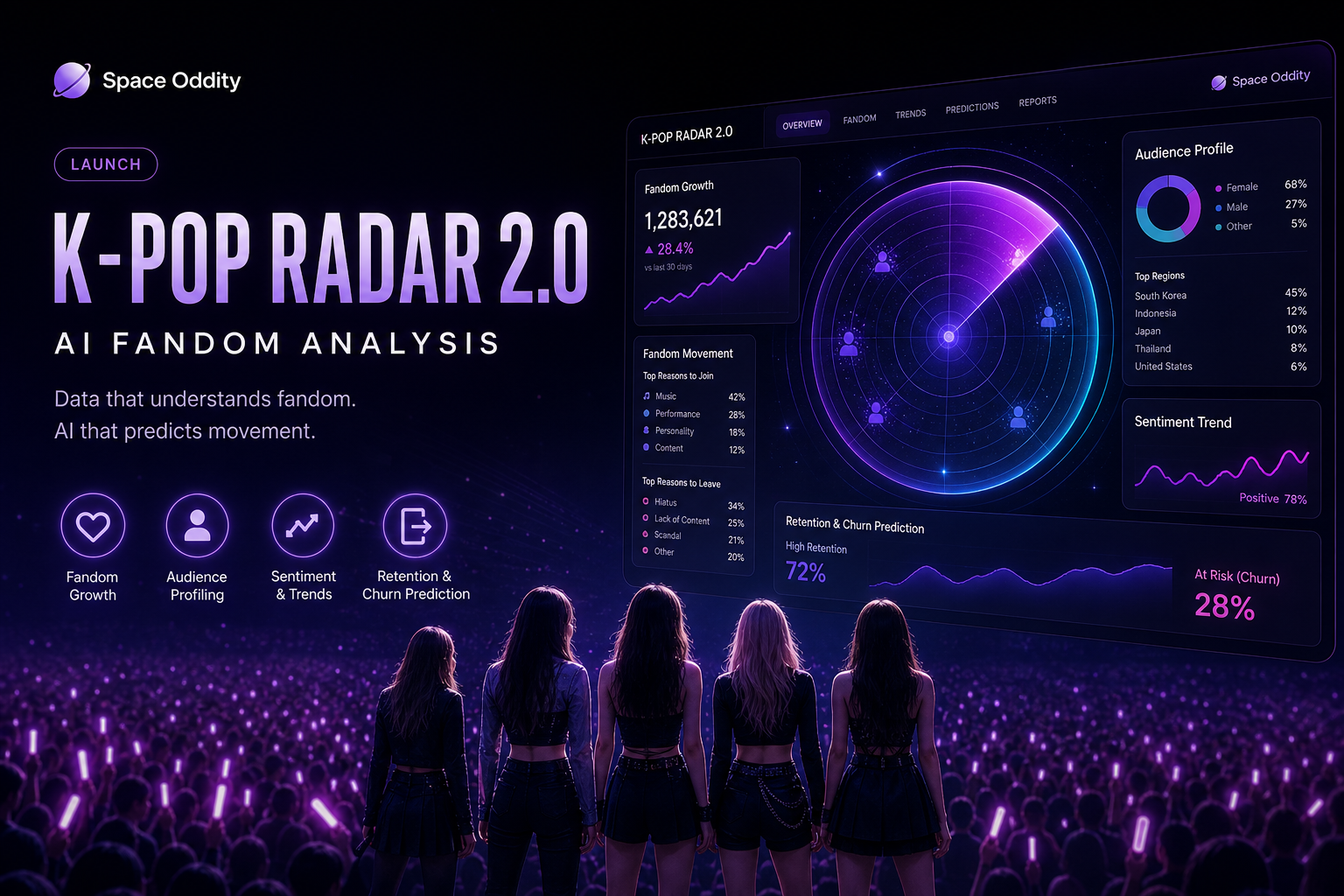
The movements of K-pop fandom no longer rely on intuition. Who opens their heart to an artist, and when and for what reason do they leave? Space Oddity is revolutionizing the K-pop industry paradigm by unveiling 'K-pop Radar 2.0,' which combines AI analysis based on over a billion pieces of extensive fandom data.
K-pop Radar 2.0 has introduced the concept of user analysis from the mobile app market to K-pop, ushering in an era of 'K-pop Intelligence.' AI precisely analyzes fandom interaction data accumulated since 2019, allowing for a clear understanding of artist fandom inflow and outflow trends, and changes in the core fanbase at a glance.
Key features include: ▲ 'Artist Image Position Map' showing an artist's visual position, ▲ 'AI-based Superfan Inflow/Outflow Analysis' detecting when superfans join and leave, ▲ 'Content Effect Peak Detection' reading the ripple effect of content, ▲ 'Multistan Artist Analysis' for fans who support multiple artists, and ▲ segmented fandom rankings, among others, providing deep insights that were previously unimaginable. In particular, multistan analysis reveals the cross-sectional structure between fandoms, aiding in the formulation of new strategies.
Up until now, the K-pop industry has remained reliant on traditional metrics such as first-week album sales or broadcast appearances. However, these were insufficient to understand the complex modern fandom structure, intricately woven with core fans, light fans, and multistan fans. K-pop Radar 2.0 transcends these limitations, providing clear answers to core questions like, "Who are our artist's fans, and whose fans are they simultaneously?" and "Where do fans gather, and where do they leave for?"
Kim Hong-ki, CEO of Space Oddity, stated, "Data-driven strategies are now essential for the K-pop industry. K-pop Radar 2.0, as a crucial infrastructure connecting artists, fans, and the industry, will become a powerful compass guiding the overall growth of the K-pop ecosystem."
K-pop Radar, which gained attention in 2019 by demonstrating the global expansion of the K-pop market with data through its 'K-pop Global Map,' has strengthened its data analysis capabilities through partnerships with Twitter in 2020 and TikTok in 2021. Now, K-pop Radar 2.0 will establish itself as a core tool for predicting and shaping the future of K-pop by reading the pulse of global fandoms through data.
What's Your Reaction?
 Like
0
Like
0
 Dislike
0
Dislike
0
 Love
0
Love
0
 Funny
0
Funny
0
 Angry
0
Angry
0
 Sad
0
Sad
0
 Wow
0
Wow
0