

Investors Bet $30B on 120-Year Careers: Are We Ready for Lifelong Learning with Bio-Sensors?
By StartupKorea Business Desk | Jun 18, 2026 The New Frontier of Lifelong EmploymentIn an era where living to 120 is no longer science fiction, an unprecedented $30 billion investment is being poured into technologies that promise to redefi...

By StartupKorea Business Desk | Jun 18, 2026
The New Frontier of Lifelong Employment
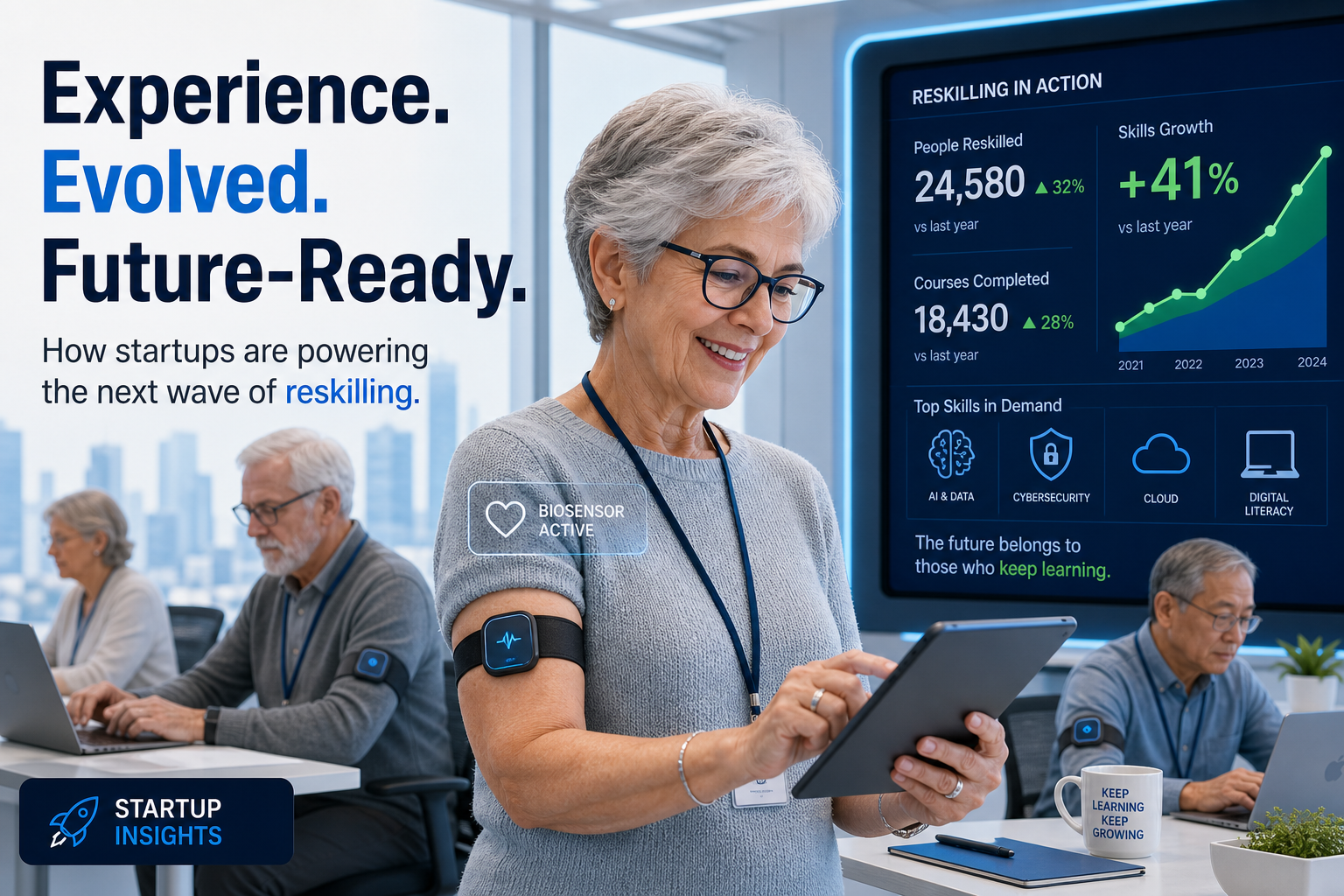
In an era where living to 120 is no longer science fiction, an unprecedented $30 billion investment is being poured into technologies that promise to redefine the workforce. As companies race to adapt to an aging population, reskilling and retraining initiatives are emerging as the hottest trends in the job market.
With the global workforce projected to face significant labor shortages over the next two decades, the urgency for innovative solutions has reached fever pitch. The idea of a 120-year career isn’t just a clever marketing ploy; it’s an impending reality that has investors frantically scouring the biotech sector for the next big thing.
A Revolutionary Tool for Workforce Adaptation
Leading the charge is NextLife Technologies, whose new ultra-low-power biosensor has caught the attention of stakeholders looking to capitalize on the reskilling market. CEO, Jonathan Treadwell, recently stated, “Our biosensors can gather real-time data on an individual’s cognitive and physical abilities, allowing companies to tailor training programs precisely to their needs.” Apparently, a mere pulse check will now determine whether employees should learn data analytics or how to knit.
NextLife’s biosensor is designed to integrate seamlessly into wearable technology, making it a perfect fit for the burgeoning market of remote and flexible work arrangements. With an estimated 65% of workers needing reskilling within the next decade, the potential applications for this technology are both vast and absurdly optimistic.
The Financial Landscape: A Gold Rush in Training
According to recent reports, the global reskilling market is projected to grow by 25% annually, potentially reaching a staggering $100 billion by 2030. This growth is fueled by the confluence of technological advancements and demographic shifts, creating a perfect storm for investors eager to capitalize on the human capital revival.
- Projected growth of the global reskilling market: 25% annually
- Estimated value by 2030: $100 billion
- Percentage of workforce needing reskilling: 65%
Meanwhile, venture capital firms are wielding their checkbooks mightily, perhaps in a bid to prove that, unlike most of their portfolio companies, they have a viable long-term strategy. “Investing in reskilling is not just about profits; it’s about saving humanity from becoming obsolete,” quipped investment guru, Linda Rothman. While investors fervently hope that a $30 billion bet will pay off, the irony remains that they could be training a workforce that may soon be replaced by AI incapable of aging.
The Risks of Over-Optimism
However, not everyone is convinced that this $30 billion investment will yield the promised utopia of lifelong learning. Critics argue that the sheer scale of the projected reskilling market is overly optimistic, suggesting a disconnect between the high-flying forecasts and the grim reality of adult education. Analyst Samuel Finch noted, “The average adult has a six-month attention span for learning new skills. Thus, the notion that people will eagerly embrace ongoing education for 120 years is, let’s say, a bit optimistic.”
Moreover, there are considerable risks associated with the integration of biosensors into workplace training. Ethical concerns arise regarding data privacy, as well as the potential for increased surveillance in what is already considered an oppressive work environment. The question remains: will employees want to wear a device that tracks not only their heartbeats but also their desire to throw the nearest stapler?
Contradicting Opinions on the Future
As the conversation unfolds, the notion of a 120-year career continues to provoke diverse opinions. Some assert that the future of work will necessitate constant adaptation and learning, while others argue that society must rethink the concept of retirement altogether. “If we’re all going to work until we’re 120, I suggest we start offering free therapy sessions, not just training programs,” remarked sociologist Dr. Selina Carter, illustrating a point often lost in the investor frenzy.
Ultimately, as the lines blur between work and life, the $30 billion question remains: are companies ready to invest in a workforce that, in their wildest dreams, will not only learn but thrive over a century of employment? Investors seem hopeful, even if the rest of us are left contemplating whether we should invest in educational Vrbo rentals for the summer of 2065.
What's Your Reaction?
 Like
0
Like
0
 Dislike
0
Dislike
0
 Love
0
Love
0
 Funny
0
Funny
0
 Angry
0
Angry
0
 Sad
0
Sad
0
 Wow
0
Wow
0