




Aideall's 'Bedivere' Wins Two CES 2026 Innovation Awards
Aidol's guide robot for the visually impaired, 'Bedivere', heated up CES 2026, opening a new horizon for future intelligent robots. Based on on-device neuromorphic artificial intelligence (AI) technology, Bedivere achieved the remarkable fe...
Editorial context: This article is part of Startup Korea's original market analysis coverage. It is written to explain startup trends, business model risks, and technology adoption signals for general information, not as investment advice.

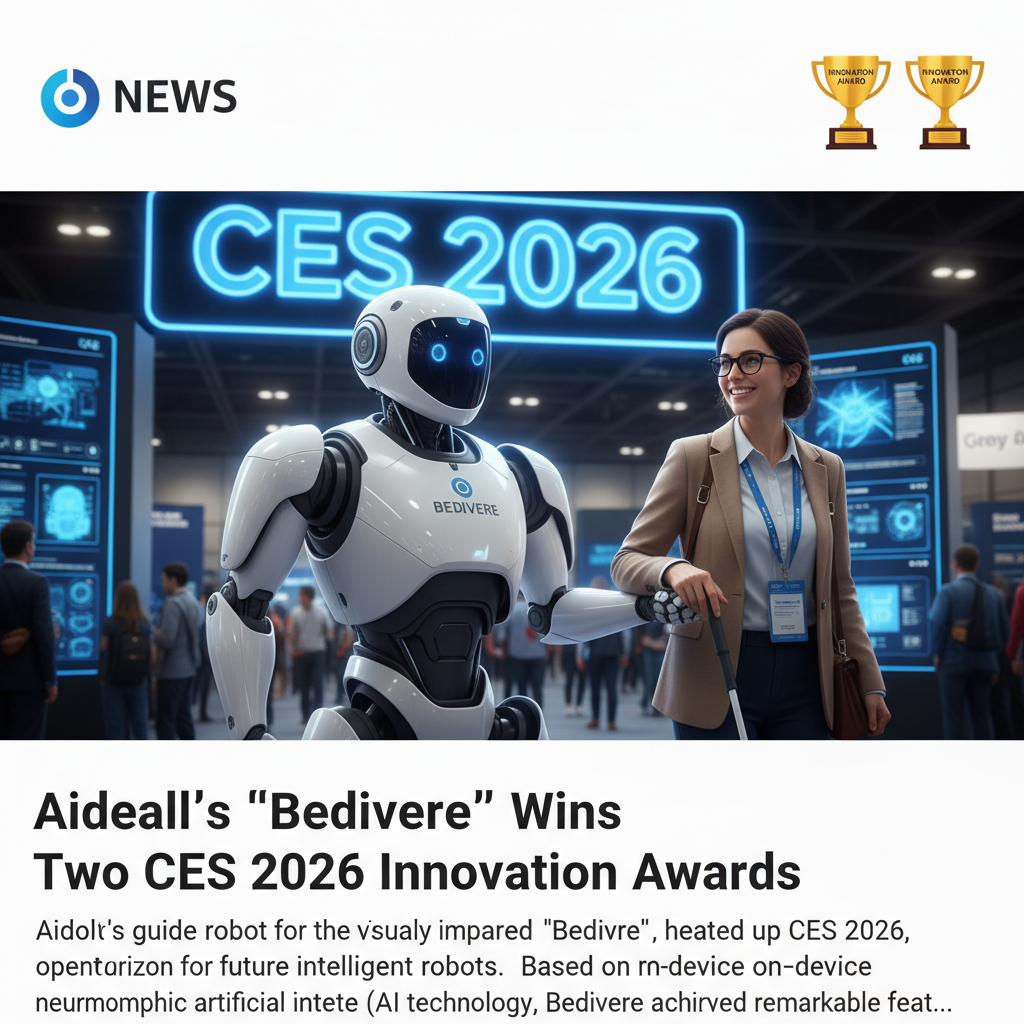
Aidol's guide robot for the visually impaired, 'Bedivere', heated up CES 2026, opening a new horizon for future intelligent robots. Based on on-device neuromorphic artificial intelligence (AI) technology, Bedivere achieved the remarkable feat of sweeping innovation awards in two categories: 'Artificial Intelligence (AI)' and 'Human Security for All (HS4A)'. In particular, the HS4A award, given in collaboration with the UN for technologies that enhance human security, clearly demonstrates the profound social value of Aidol's technology.
CEO Kim Jepil points out, "While current mainstream large AI models are proficient in high-level reasoning, they have clear limitations: massive power consumption, lack of real-time response, and adaptability." He cited the absence of an 'artificial cerebellum' as the reason for the lack of real-time capability, which is crucial for robot control, and emphasized that centralized large models struggle to respond immediately to unpredictable changes in the physical world.
Aidol solved this challenge with its proprietary neuromorphic AI architecture, which acts as an 'artificial cerebellum', namely 'Self-Referenced Control (SRC)' technology. This is a 'complementary AI' structure where, when a DNN (cerebrum) issues a high-level command like "Go to the destination," the SRC-based 'artificial cerebellum' reacts in real-time to actual physical environmental changes, precisely controlling the robot. CEO Kim likened this to the cerebellum's predictive control intelligence, like an "outfielder moving to catch a fly ball," explaining that it can react swiftly to environmental changes even in a low-power, on-device setting.
In his acceptance speech, CEO Kim emphasized, "While everyone was focused on developing the 'cerebrum' of robots, Aidol concentrated on creating the 'cerebellum' that would receive commands from the cerebrum and move in the physical world." He expressed the ambition that this innovative 'cerebellum' technology will alleviate daily mobility inconveniences for approximately 300 million people worldwide with low vision and visual impairments, and present them with a better life. Established in December 2023, Aidol is a technology startup developing intelligent robots based on on-device computing and neuromorphic AI, leading future technology by introducing Bedivere, an autonomous guide robot for the visually impaired, as its first commercial model.
What's Your Reaction?
 Like
0
Like
0
 Dislike
0
Dislike
0
 Love
0
Love
0
 Funny
0
Funny
0
 Angry
0
Angry
0
 Sad
0
Sad
0
 Wow
0
Wow
0