




Startup Launches Sentiment Analysis Tool for Git Commits Amid $30 Million Funding Frenzy: Because Code Needs Feelings Too
By StartupKorea Business Desk | May 29, 2026 Startup Launches Sentiment Analysis Tool for Git Commits Amid $30 Million Funding Frenzy: Because Code Needs Feelings TooIn an unprecedented move that has left the tech community both baffled and...

By StartupKorea Business Desk | May 29, 2026
Startup Launches Sentiment Analysis Tool for Git Commits Amid $30 Million Funding Frenzy: Because Code Needs Feelings Too
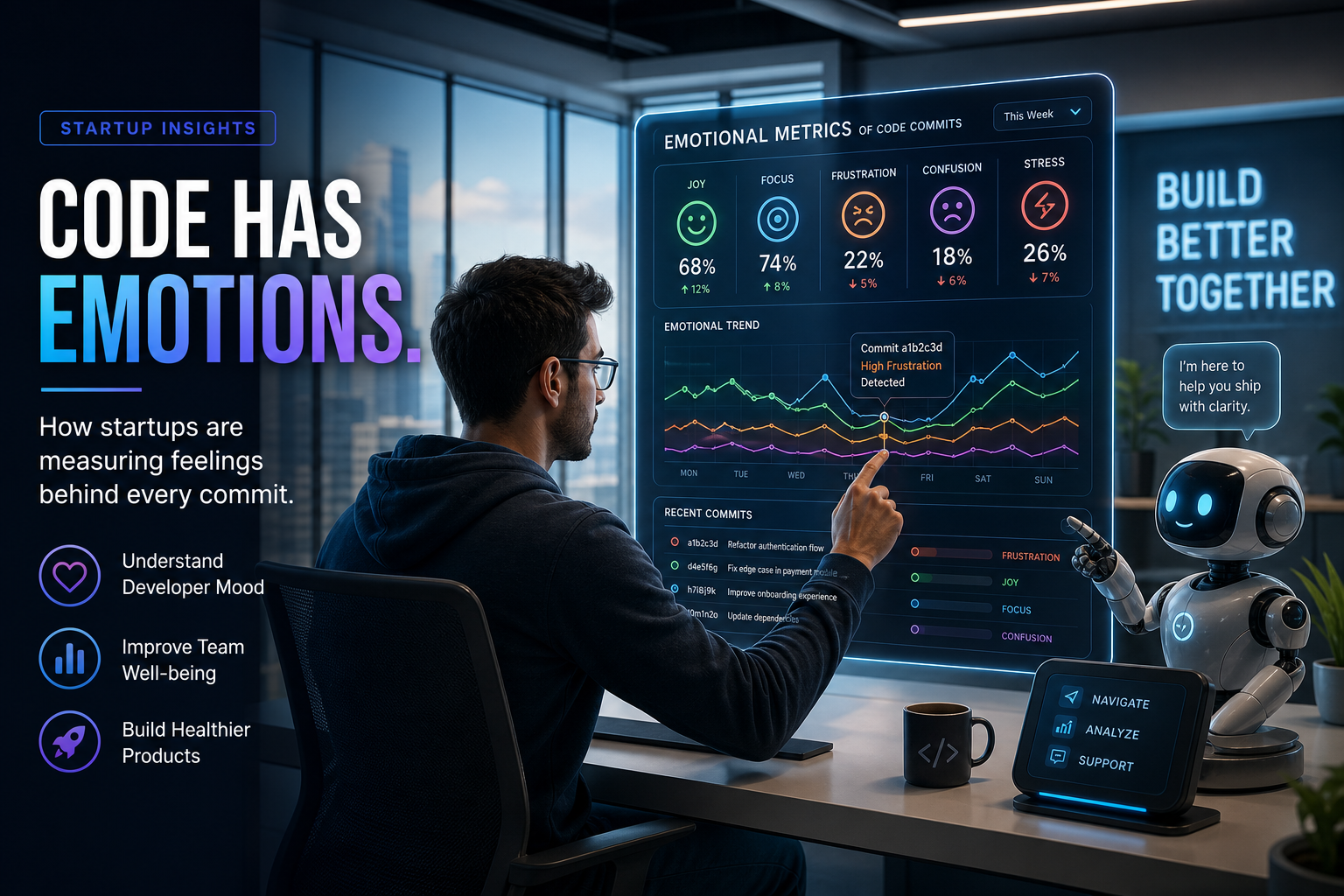
In an unprecedented move that has left the tech community both baffled and oddly intrigued, CodeEmote, a California-based startup, has announced a $30 million strategic investment round for its groundbreaking sentiment analysis tool designed explicitly for Git commits. This cutting-edge software promises to read between the lines of developers' code comments—because why should machines only interpret syntax when they can also interpret emotions?
Why Now? The Emotional Void of Coding
The announcement comes amid a growing recognition that software developers may be experiencing an emotional crisis. According to a recent survey, 73% of developers admitted to feeling “underappreciated” by their code, with 89% expressing a desire for their commits to carry more emotional weight. In a market where 80% of startups fail within their first two years, CodeEmote is betting on the idea that helping code express its feelings might just be the ticket to success.
Investors Buy into the Vision
The funding round was led by Vain Ventures, a firm known for backing companies with “quirky” business models. “We see an incredible potential in teaching code to communicate its feelings,” said Mark Witty, CEO of Vain Ventures. “In a world where everything has a sentiment—except Git commits—this product is the emotional intelligence revolution we didn’t know we needed.”
Analysts are cautiously optimistic. “CodeEmote is tapping into a niche market that might not exist, but if it does, they’ll be the first to exploit it,” said tech analyst Julia Conundrum. “It’s a risky bet, but in the startup world, you can’t be afraid to swing for the fences—even if the bases are empty.”
To Infinity and Beyond: The Market Context
The sentiment analysis market is projected to grow to $6 billion by 2027, but CodeEmote's ability to penetrate even a fragment of that market is still up for debate. With competitors like SentiCode, which tracks emotional trends in programming communities, the landscape is becoming increasingly saturated. Can a focus on Git commits truly differentiate CodeEmote in the eyes of investors and users alike?
- Sentiment analysis market projected growth: $6 billion by 2027
- 73% of developers feel unappreciated by their code
- 89% desire emotional depth in commits
The Risks and Constraints of an Emotional Revolution
While the concept is intriguing, it raises several questions. For one, how does a line of code express sadness or joy? Can a Python script suffer a breakdown, or will it merely execute a syntax error? Furthermore, the emotional reliability of the analysis tool is still untested—what if it misinterprets a sarcastic comment as genuine praise? The implications could be catastrophic, leading to a repository of overly confident yet ultimately misguided software.
Moreover, potential users are skeptical. “I’m not sure I need a tool to tell me that my code is sad,” quipped developer Sam Syntax. “If my code could talk, it would probably just ask for more comments and better documentation.”
Robot Vision Navigation: A Sidekick to the Emotional Algorithm
In a surprising twist, CodeEmote plans to integrate a robot vision navigation feature that allows the tool to ‘see’ the emotional landscape of a project. “Imagine a robot that not only analyzes your commits but also navigates through your codebase to provide emotional support,” said Chief Technical Officer Lila Emotiona. “It’s like having a therapist for your code.”
As developers continue to struggle with mental health challenges, the idea of a supportive robot navigating through their emotional code seems oddly appealing, if not entirely feasible. The integration of robot vision poses further questions about how much technology should be involved in the mental wellness of developers and whether this is the future of collaborative coding or just another dystopian fantasy.
A Satirical Venture into the Unknown
As CodeEmote embarks on its emotionally charged journey, the tech community waits with bated breath. Will this tool revolutionize coding, or will it become another footnote in the annals of startup history? One thing is for sure—whether CodeEmote succeeds or flops, it has certainly captured the zeitgeist of a generation craving deeper connections, even from their code.
In a world where emotional intelligence is increasingly valued, perhaps teaching code to feel is the next logical step in our digital evolution. After all, if your Git commits can cry, you might just find the path to a more harmonious coding environment—or at least a few more likes on GitHub.
What's Your Reaction?
 Like
0
Like
0
 Dislike
0
Dislike
0
 Love
0
Love
0
 Funny
0
Funny
0
 Angry
0
Angry
0
 Sad
0
Sad
0
 Wow
0
Wow
0