




Revolutionizing Thrift: New Resume Platform Pairs Job Seekers with Vintage Wardrobes—What's Next, Couture Interviews?
By StartupKorea Business Desk | Apr 16, 2026 Revolutionizing Thrift: New Resume Platform Pairs Job Seekers with Vintage Wardrobes—What's Next, Couture Interviews?In an unexpected twist that could only be described as delightfully absurd, th...

By StartupKorea Business Desk | Apr 16, 2026
Revolutionizing Thrift: New Resume Platform Pairs Job Seekers with Vintage Wardrobes—What's Next, Couture Interviews?
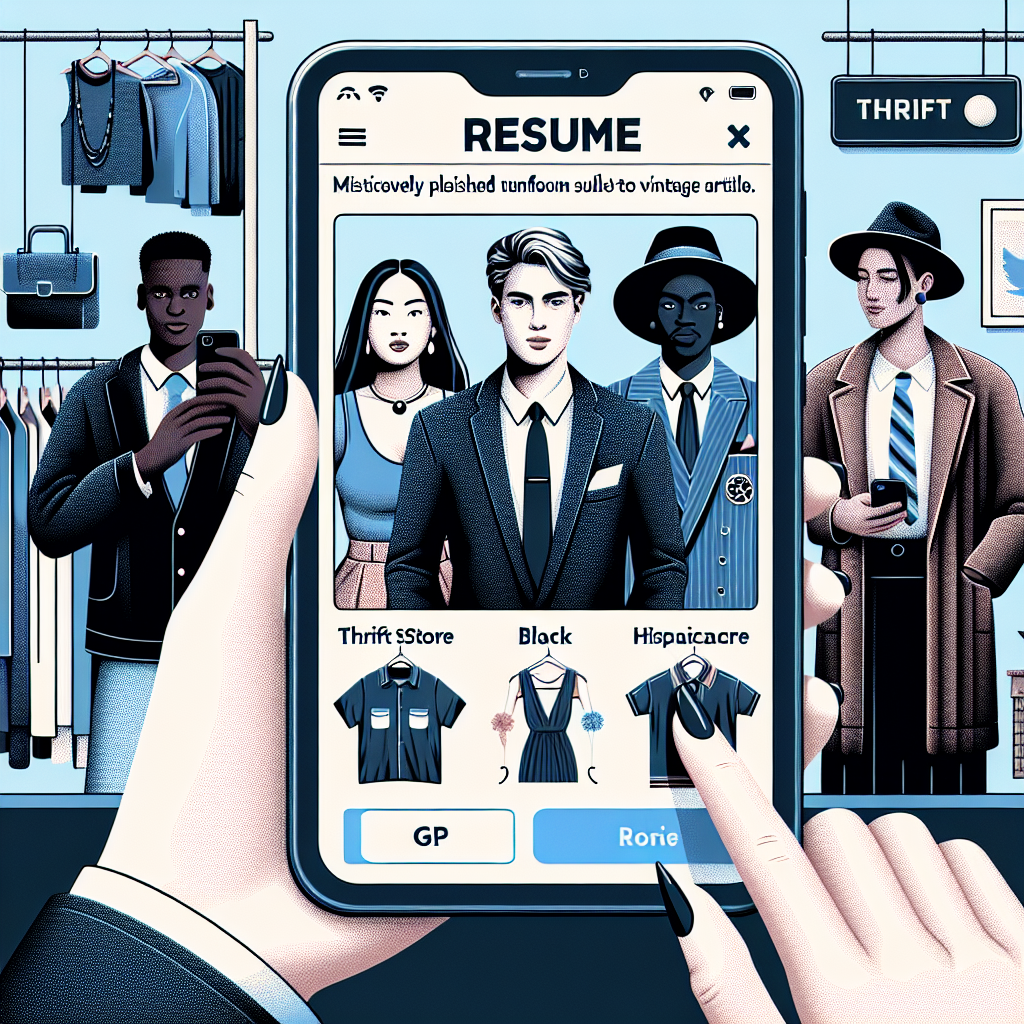
In an unexpected twist that could only be described as delightfully absurd, the recently launched startup ThriftChain has secured a staggering 30 billion won in strategic investments to develop a resume platform for second-hand clothing. This venture comes at a time when the fashion industry faces an existential crisis, scrambling to make sense of sustainability while simultaneously courting the whims of Gen Z.
A Match Made in Thrift Heaven
ThriftChain's premise is as simple as it is ludicrous: aspiring job seekers will now be able to showcase their second-hand wardrobe as part of their qualifications. The platform utilizes Ultra-Wideband (UWB) mesh technology to pinpoint the location of vintage garments—because why not turn thrift shopping into a GPS-enabled treasure hunt?
“It’s about merging fashion with functionality,” said ThriftChain CEO, Clara Dressman. “Why should your wardrobe be a mere collection of clothes when it can double as a resume? With our platform, you’re not just applying for a job; you’re making a fashion statement.”
The Numbers Game: A Fashionable Investment
The investment, announced on April 15, 2026, marks a significant milestone in the intersection of technology and fashion, with the global second-hand apparel market projected to reach $64 billion by 2024. Investors are clearly betting on the notion that a blazer worn by a previous CEO might just be the golden ticket to landing that coveted job.
- Projected global second-hand apparel market: $64 billion by 2024
- Investment secured by ThriftChain: 30 billion won
- Growth of resale fashion market: 69% increase since 2021
Risks and Wardrobe Malfunctions
However, not everyone is enthralled by this sartorial shake-up. Industry analyst, Mark Sartorial, cautioned that the risks are as apparent as a poorly fitted blazer. “There’s a thin line between innovative and ridiculous. Are employers really going to assess skills based on how well someone can rock a thrift store find?”
Furthermore, the UWB technology, although cutting-edge, poses its own challenges. Critics argue that relying on location-based mesh networks to locate garments could lead to unnecessary complications. After all, haven’t we had enough of locating our misplaced socks?
Thrive or Dive: The Critics Speak
Some critics have gone so far as to label the venture as “fashionably negligent.” As one disgruntled investor put it, “If I wanted to hire someone based on their wardrobe, I’d just look at their Instagram.”
Despite the skepticism, ThriftChain has already begun to attract a dedicated user base among young professionals eager to fuse their job-seeking endeavors with their passion for sustainable fashion. This duality has sparked a cultural phenomenon, and it seems the startup may not be merely a flash in the pan.
The Future of Employment and Apparel
As this trend unfolds, one must wonder how far the concept of a 'fashion resume' can stretch. Will thrifted attire soon become mandatory at job interviews, or could we see the rise of ‘clothes consultants’ who specialize in helping candidates build their wardrobes as they build their careers?
Ultimately, ThriftChain’s success may depend not just on its technology and investment, but on the job market’s willingness to embrace this new fashionable frontier. In a world where the only thing more fragile than a resume is a vintage silk blouse, the stakes are high—high enough to warrant a tailored suit.
What's Your Reaction?
 Like
0
Like
0
 Dislike
0
Dislike
0
 Love
0
Love
0
 Funny
0
Funny
0
 Angry
0
Angry
0
 Sad
0
Sad
0
 Wow
0
Wow
0