

95% of Chinese Customers, China Unaware
China Market: Conquer the Unavoidable 'Final Boss' The COMUP 2025 Future Talk session on December 11 vividly illustrated what the Chinese market means for Korean startups. Kim Nam-guk, Head of EIV at Eland China, Gong Jeong-hyun, CEO of SMI...
Editorial context: This article is part of Startup Korea's original market analysis coverage. It is written to explain startup trends, business model risks, and technology adoption signals for general information, not as investment advice.

China Market: Conquer the Unavoidable 'Final Boss'
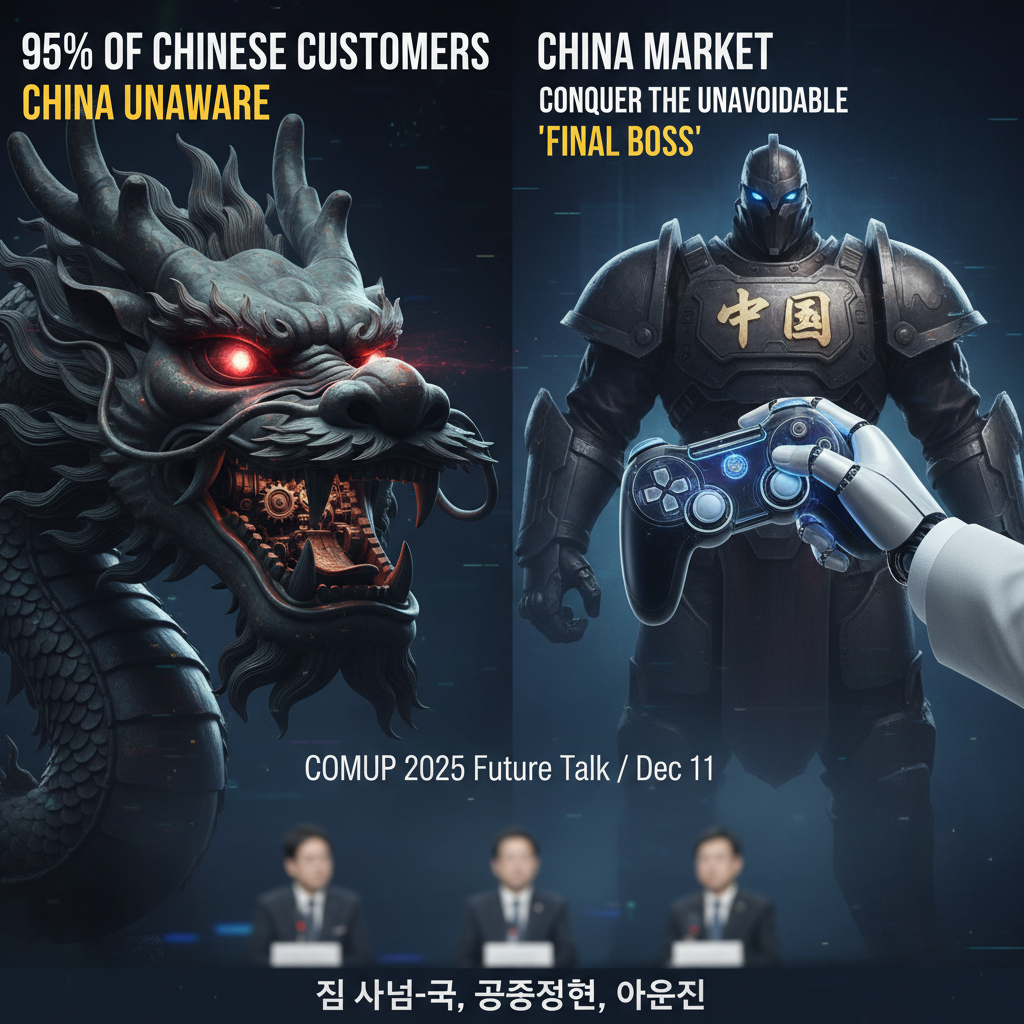
The COMUP 2025 Future Talk session on December 11 vividly illustrated what the Chinese market means for Korean startups. Kim Nam-guk, Head of EIV at Eland China, Gong Jeong-hyun, CEO of SMIM, and Oh Eun-jin, CEO of INNERBOOTH, unanimously likened China to 'the final boss of a game,' emphasizing the need to find opportunities within its immense size and complexity. As Gong Jeong-hyun, CEO of SMIM, said, "It looks big, it looks like we'll lose, and it looks difficult, but bosses are there to be defeated, aren't they?" Now, China is becoming an inevitable stage, not just an option, for Korean startups.
SMIM, which operates the K-pop fan support platform 'Daily Duck,' has 95% of its customers from China. Seeing these users flow in naturally without special promotion, CEO Gong personally visited the Shanghai market last April. Then in September, he opened a pop-up store at Parkson-Newcore and was deeply surprised by the passionate enthusiasm of Chinese fans who visited daily. His recollection that "the passion was even higher than in Korea" clearly demonstrates the potential of the Chinese consumer market.
Oh Eun-jin, CEO of INNERBOOTH, which connects Korean character IPs with global brands, also witnessed immense opportunities, with Chinese licensing contract sizes reaching 5 to 10 times that of Japan. While amazed by overwhelming IP retail spaces like Shanghai's 'Joy City,' she also encountered huge obstacles such as partner verification, IP protection, and information asymmetry. CEO Oh's frustration, expressing "Is this really true? Is this all there is?", reflected a common problem for Korean companies craving information about the Chinese market, which had been disconnected for the past decade.
Kim Nam-guk, Head of EIV, who assisted them on their Shanghai business trip, defined China as a 'unique world' 10 times the size of Korea's GDP, leading global standards from manufacturing to commerce. He emphasized that understanding the unique system where officials' KPIs are tax revenues is essential, and utilizing this can lead to encountering local partners with unexpected authority. Furthermore, his explanation that "the Hallyu ban is not officially in use, and they are proactive if it can contribute to the industry" suggests a high demand for original Korean content like K-pop and the importance of local influence.
The reality that Chinese retailers like Miniso and Pop Mart are dominating the world, and original IPs like Labubu are growing, is clearly 'a major threat.' However, as Head Kim noted, it is also 'a major opportunity' for Korean IPs to grow through thousands of retail brands. As CEO Gong Jeong-hyun's analogy suggests, China is the final boss at a 'stage that absolutely must be conquered.' Breaking down the barriers of information asymmetry, understanding the essence of the Chinese market, and leveraging local systems to seize opportunities—that will be the unavoidable task and the key to success for Korean startups. It may seem vast and difficult, but ultimately, the boss must be defeated to advance to the next level.
What's Your Reaction?
 Like
0
Like
0
 Dislike
0
Dislike
0
 Love
0
Love
0
 Funny
0
Funny
0
 Angry
0
Angry
0
 Sad
0
Sad
0
 Wow
0
Wow
0