


5 Korean Startups Shine at Chengdu, China's 'Golden Panda'
The Incheon Center for Creative Economy & Innovation (hereinafter referred to as Incheon Center) led Korean startups to brilliant performances at the finals of the '2025 7th Golden Panda Global Innovation and Entrepreneurship Competition' a...
Editorial context: This article is part of Startup Korea's original market analysis coverage. It is written to explain startup trends, business model risks, and technology adoption signals for general information, not as investment advice.

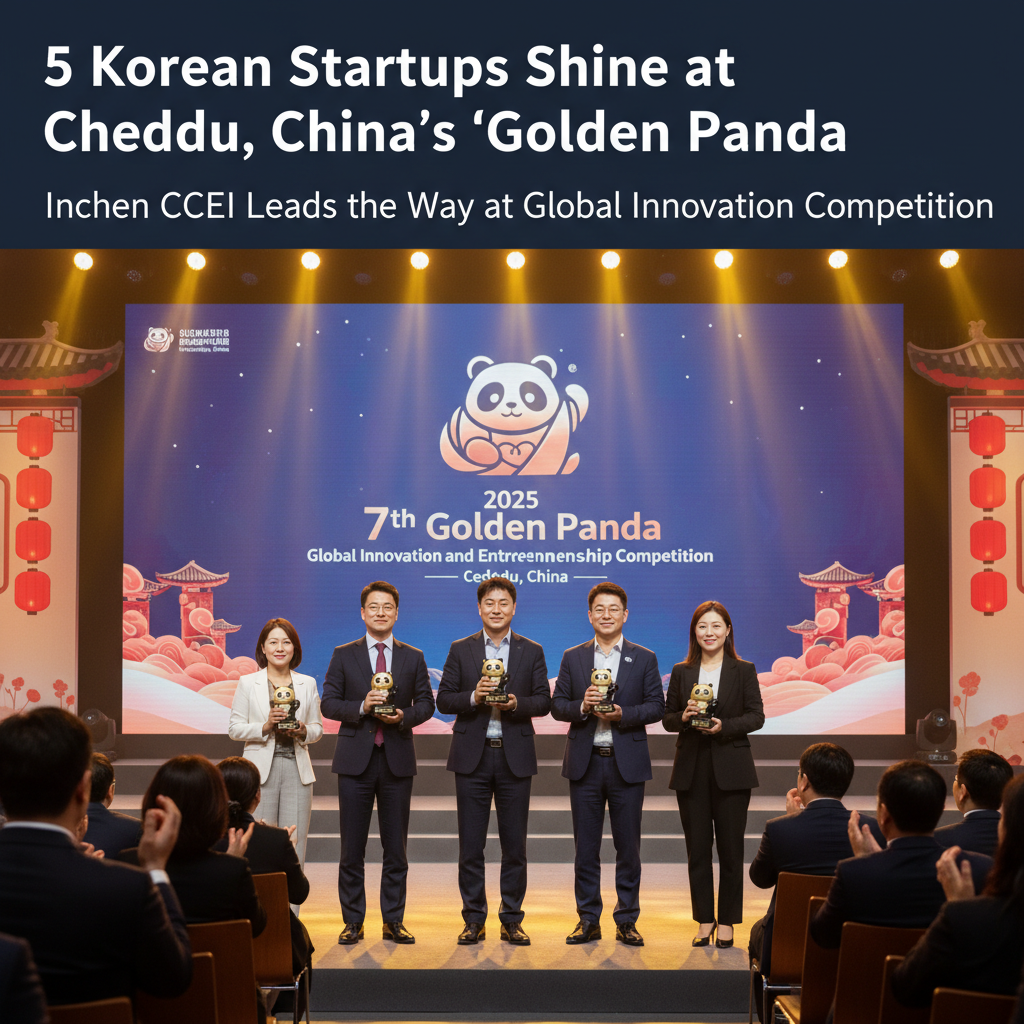
The Incheon Center for Creative Economy & Innovation (hereinafter referred to as Incheon Center) led Korean startups to brilliant performances at the finals of the '2025 7th Golden Panda Global Innovation and Entrepreneurship Competition' and the '1st Korea-China-Japan Cultural Content Startup Competition' held in Chengdu, China, proving their global competitiveness. In this competition, held from November 2nd to 5th, five Korean startups received awards.
Following last year, the Incheon Center participated as a co-organizer for the Korean region of the Golden Panda Competition for two consecutive years, and successfully managed the Korean preliminaries for the newly established Korea-China-Japan Cultural Content Competition this year. Sixteen Korean startups, who advanced to the finals after overcoming a high competition rate of approximately 9:1, showcased various innovative technologies, including artificial intelligence (AI), biopharmaceuticals, energy/materials/components/equipment, and XR content, drawing significant attention.
In particular, Adova (CEO Ahn Jun-han), which showcased an AI creator content cross-border solution, won second place, widely publicizing the technological prowess of Korean startups. Hypercloud (CEO Park Gyeong-gyu) with its XR content solution utilizing AI indoor positioning technology, and Broz (CEO Kim Chan-il) with its 3D space automatic generation AI solution 'FAVIEW', both received third place awards, acknowledging their innovativeness. Furthermore, New Universe (CEO Jeong Ho-young) with its K-short form drama production and IP creation platform, and Pove (CEO Jo Seong-ho) with its AI-based XR virtual tourism solution, received excellence awards, demonstrating the strength of Korean startups.
This final round transcended mere competition, becoming a venue for practical business exchange. Korean participating companies explored opportunities for entering the Chinese market and collaborating on joint research and development through active business matching programs with local Chinese partners and investors, with some companies already achieving concrete discussions.
Furthermore, during this visit, the Incheon Center achieved a remarkable feat by signing a business agreement with the Sichuan Provincial Technology Transfer Center (四川省技术转移中心) in China. This is regarded as establishing an important bridgehead for domestic startups to expand technology exchange and technology transactions with companies within Sichuan Province, China. The Incheon Center, which has consistently exchanged with Chengdu Hi-Tech Zone since 2016, will use this agreement as an opportunity to broaden its scope of cooperation to cover the entire Sichuan Province, further strengthening its foundation for entering the Chinese market.
Lee Han-seop, CEO of Incheon Center for Creative Economy & Innovation, emphasized, "This achievement is the culmination of years of exchange that the Incheon Center has maintained, centered in Chengdu, China, and an opportunity to prove the outstanding technological capabilities of Korean startups on the global stage." He continued, "Through cooperation with the Sichuan Provincial Technology Transfer Center, we have laid the foundation for Korean startups' technologies to lead to practical transactions such as technology transfer and joint development with local companies," and expressed his ambition, "Moving forward, we will strengthen the open innovation network between Korea and China, and expand our global entry programs beyond China to across Asia, including Malaysia and Vietnam." The role of the Incheon Center in the global growth of Korean startups is highly anticipated.
What's Your Reaction?
 Like
0
Like
0
 Dislike
0
Dislike
0
 Love
0
Love
0
 Funny
0
Funny
0
 Angry
0
Angry
0
 Sad
0
Sad
0
 Wow
0
Wow
0