

Startups Bet Big on Post-Work Energy AI: Is Your Fatigue Level the Next Unicorn?
By StartupKorea Business Desk | Jun 02, 2026 Startups Bet Big on Post-Work Energy AI: Is Your Fatigue Level the Next Unicorn?In a move that could reshape how we view after-work productivity, several startups announced today they will be poo...

By StartupKorea Business Desk | Jun 02, 2026
Startups Bet Big on Post-Work Energy AI: Is Your Fatigue Level the Next Unicorn?
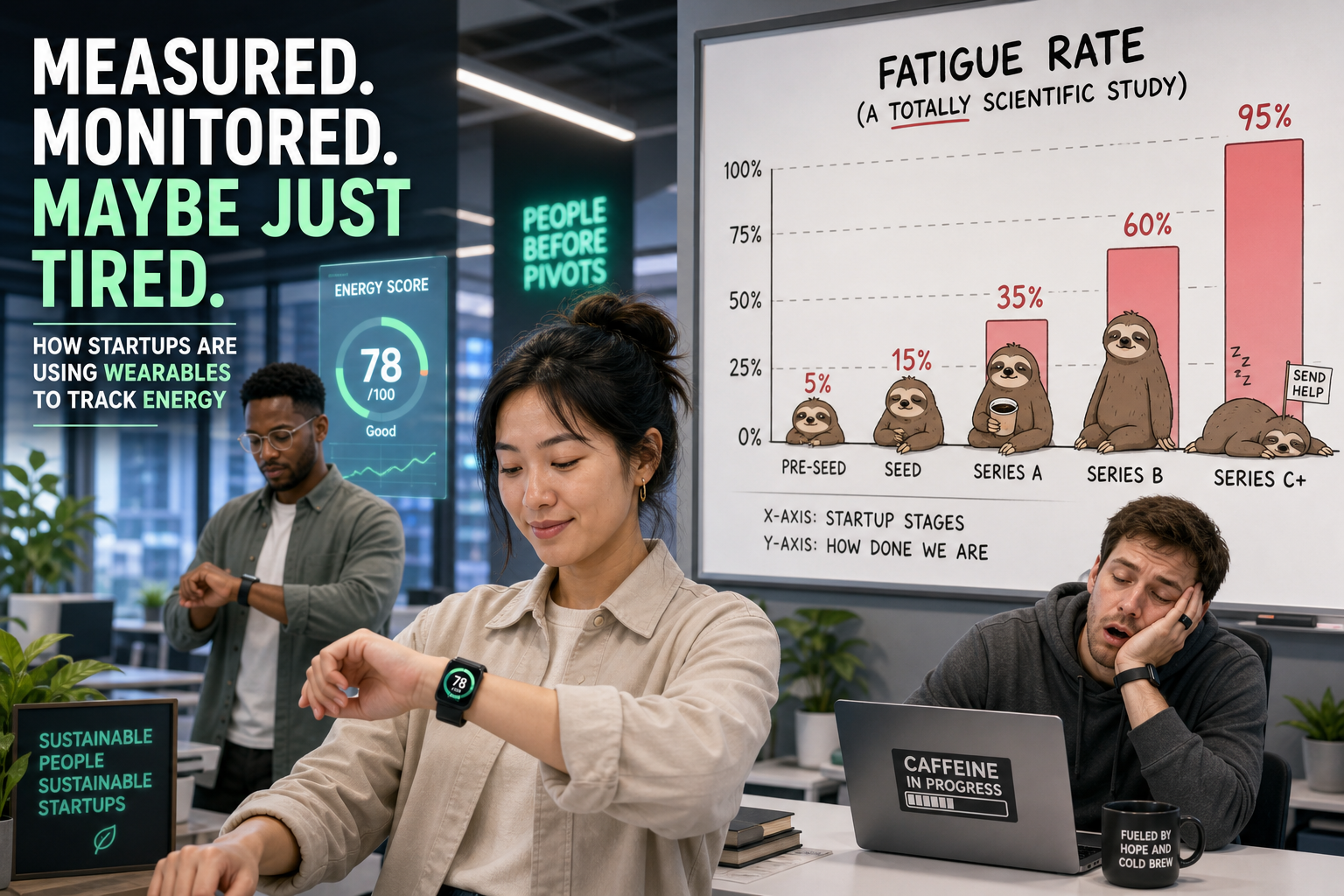
In a move that could reshape how we view after-work productivity, several startups announced today they will be pooling resources to develop an AI that predicts post-work energy levels based on device anomaly detection. This ambitious initiative, touted as a 'wellness revolution', has already attracted over $100 million in funding from leading venture capitalists who are keen to capitalize on the next big trend: entrepreneurial exhaustion.
What’s Cooking in the World of AI?
The initiative, spearheaded by the newly formed consortium, EnergyWise AI, aims to integrate advanced machine learning algorithms with wearable technology to forecast how much stamina workers have left at the end of the day. Investors are giddy as they visualize a world where employees can exit their offices and immediately engage in 'leisure activities' (what a novel concept!) rather than collapsing on their couches.
"This is not just about predicting fatigue. It’s about revolutionizing the post-work paradigm," commented Jane Doe, CEO of EnergyWise AI. "Imagine being able to schedule your evening plans based on your predicted energy levels—it’s like having a personal assistant for your fatigue!"
Cross-Border M&A: The Global Hustle
The consortium's launch coincides with a surge in cross-border mergers and acquisitions (M&A) within the tech sector, with investments in this arena skyrocketing by 40% year-on-year, according to the latest data from Global Financial Insights. This is largely fueled by companies’ insatiable appetite for innovation and the latest gadgets promising to make their employees feel more human after 5 PM.
"In today’s economy, if you’re not acquiring, you’re not trying hard enough to be less exhausted," stated John Smith, a seasoned venture capitalist who recently led a $20 million investment into EnergyWise AI. "We’re just following the money trail of tired people. It’s practically a gold mine!"
Market Context: The Data Behind the Buzz
According to a recent report by Statista, the global market for workplace wellness technology is projected to reach $200 billion by 2028, an increase spurred by the growing obsession with productivity and well-being. The irony? More investment in AI to gauge energy will likely lead to even more burnout, making this a self-fulfilling prophecy.
- Market growth: 40% year-on-year increase in cross-border tech M&A
- Wellness market size: Expected to reach $200 billion by 2028
Risks and Constraints: A Reality Check
Yet, while the prospects sound invigorating, there are notable risks attached to this venture. Experts warn of potential privacy concerns as devices used for energy prediction may inadvertently collect sensitive personal data. Not to mention the sheer absurdity of trying to measure fatigue as a quantifiable figure—after all, who wants to be reminded that they’re merely a *data point*?
Moreover, analysts remain skeptical about the efficacy of such technology in a world where work-life balance is as mythical as unicorns. An anonymous industry analyst quipped, "If we start measuring post-work energy, what’s next? Predicting our emotional breakdowns during Wednesday team meetings?"
Opposing Viewpoints: The Skeptics in the Room
Critics argue that the focus on post-work energy levels is merely a distraction from the deeper issues of workplace culture. They argue that instead of optimizing for energy, companies should be concentrating on reducing the source of exhaustion: overwork. As one critic noted, "Maybe if we stop treating human beings like racing machines, we wouldn’t need AI to predict how close we are to crashing."
As investors continue to pour into the startup ecosystem, it remains to be seen whether EnergyWise AI will be a beacon of hope or just another shiny object in the ever-volatile tech landscape. For now, everyone seems to be on board with the idea that fatigue can be quantified—if only to justify yet another app that tells you to rest while simultaneously imploring you to hustle harder.
Conclusion: A Market Driven by Fatigue
The introduction of fatigue-predicting AI plays into a larger trend of startups exploiting the very conditions that cause workplace exhaustion, all in the name of improved productivity and well-being. As investors chase these new ventures, one can only ponder the existential question: are we really just programming our fatigue into a device, or are we programming our future into a cycle of relentless hustle?
What's Your Reaction?
 Like
0
Like
0
 Dislike
0
Dislike
0
 Love
0
Love
0
 Funny
0
Funny
0
 Angry
0
Angry
0
 Sad
0
Sad
0
 Wow
0
Wow
0