





AI Basic Act Imminent: 97% of Startups Unaware, Unprepared
The majority (97%) of domestic startups were found to have either insufficiently understood the content of the AI basic law or were inadequately prepared, ahead of its implementation. According to a survey by Startup Alliance, nearly half (...

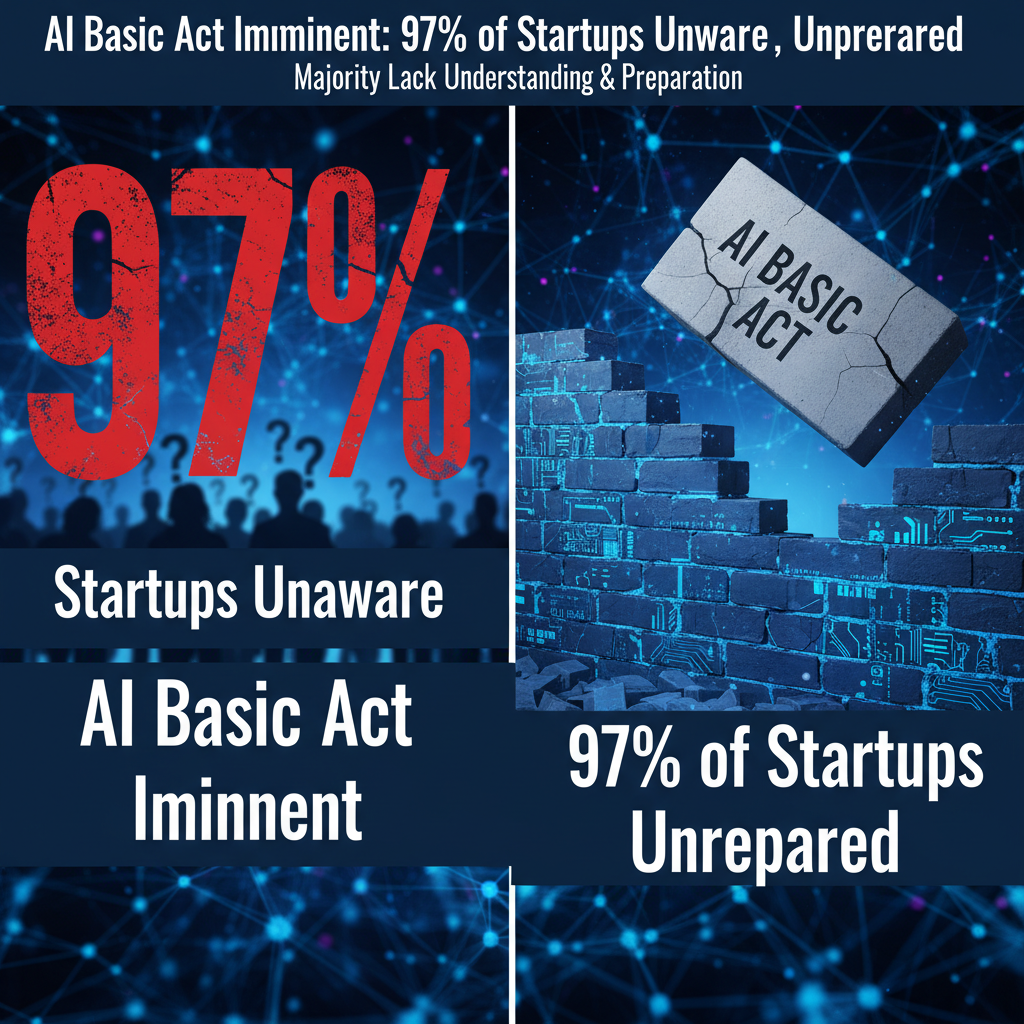
The majority (97%) of domestic startups were found to have either insufficiently understood the content of the AI basic law or were inadequately prepared, ahead of its implementation. According to a survey by Startup Alliance, nearly half (48.5%) of the responding companies were unaware of the content, while the other half (48.5%) were aware but had insufficient preparedness. Specifically, early-stage companies lacked awareness of the bill's content, and even late-stage companies, despite being aware, had inadequate practical responses.
The clauses that startups were most concerned about were, in order: 'AI reliability and safety certification system' (27.7%), 'requirement to ensure dataset transparency' (23.8%), 'designation of high-impact AI and obligation for prior registration and verification' (17.8%), and 'obligation to label generative AI outputs' (15.8%).
Specifically, regarding the verification and certification system, service launch delays (38.2%) and cost burden (35.5%) were cited as major constraints. Concerning transparency and disclosure obligations, the overly comprehensive definition of generative AI (45.5%) and unclear scope of disclosure (38.6%) were identified as problems. The high-impact AI designation system was found to impose a significant burden due to vague criteria (27.7%) and the practical difficulty of explaining training data (19.8%). The obligation to label generative AI outputs was cited with difficulties such as uniform labeling for all outputs (39.5%) and increased burden of copyright and source management (25.6%).
In response, the report put forth four policy recommendations. First, for high-impact AI regulations, concrete criteria and realistic procedures must be established first. Second, the obligation to label generative AI needs a differentiated approach considering the characteristics of each medium. Third, the computational capacity standard should be shifted to an 'AI model' standard to avoid applying criteria beyond the control of startups. Fourth, it was proposed that the requirements for initiating fact-finding investigations should be strengthened to reduce regulatory risks, making investigations difficult for mere complaints or minor violations. This reflects the demand for realistic legal application and supplementation to ensure that the AI basic law does not hinder the innovation of domestic startups.
What's Your Reaction?
 Like
0
Like
0
 Dislike
0
Dislike
0
 Love
0
Love
0
 Funny
0
Funny
0
 Angry
0
Angry
0
 Sad
0
Sad
0
 Wow
0
Wow
0